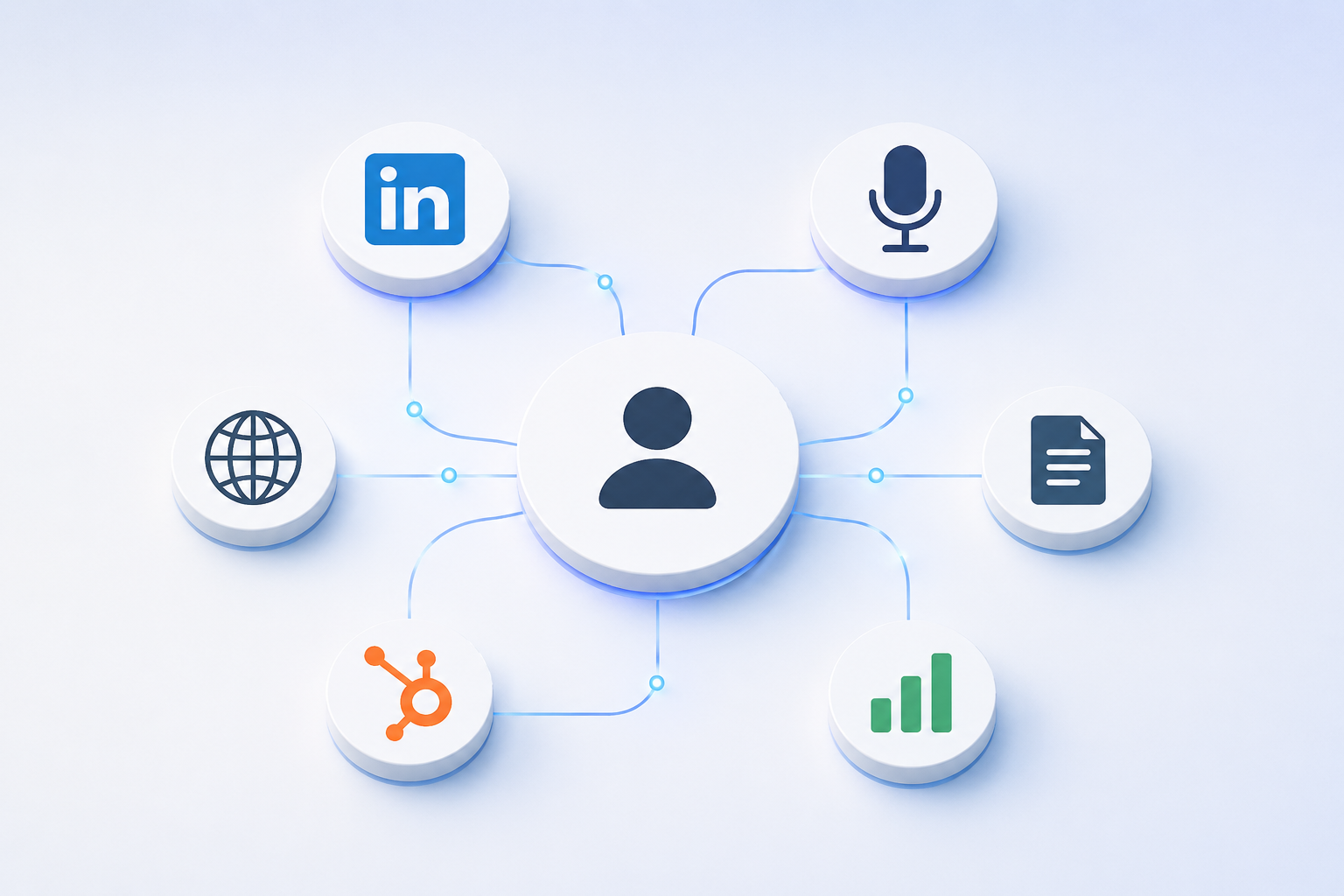
Most companies do not have a lead generation problem. They have a "what happens after the lead arrives" problem, and it is quietly costing them revenue every single week.
TL;DR
- Lead generation is not the bottleneck for most companies. The handoff between marketing and sales is where deals actually die.[2]
- A closed-loop process gives every lead an owner, a next action, and a measurable outcome at every stage, not just a status.
- Handoffs should transfer context, not just contact information, so sales never starts a conversation from zero.[4]
- Tracking lead sources all the way into the deal pipeline turns marketing attribution into a revenue conversation instead of a vanity metric.[6]
- Speed and follow-up discipline still decide outcomes. Most leads that convert take five or more touches, and most reps stop after one or two.[13]
- HubSpot can automate most of this: lifecycle stages, lead ownership, task creation, and reporting all live in one system when it is set up correctly.[9]
Why Companies Can Generate Plenty of Leads and Still Lose Revenue
Marketing hits its lead targets. Sales still says the pipeline is thin. Both can be true at the same time, and the gap between them almost always lives in the handoff.
Roughly 90 percent of sales and marketing professionals report disconnects across strategy, process, and content between the two teams.[2] That disconnect is not just a communication problem. It shows up as leads sitting with no clear owner, no defined next action, and no deadline attached to either one. When a handoff happens through a tool notification or a status change instead of a documented process, it tends to be inconsistent, and that inconsistency is what lets qualified opportunities go cold.[1]
Poor data quality compounds the problem. When information is not captured, cleaned, or synced correctly between the marketing platform and the CRM, leads get lost, duplicated, or assigned to the wrong owner, and mismatched definitions of "qualified" make things worse before a rep ever picks up the phone.[3]
The fix is not more leads. It is a closed-loop process where every lead has an owner, a next step, and a way to measure whether that step actually happened.
1. Map the Entire Lead-to-Revenue Workflow, Not Just MQL to SQL
Most teams stop mapping the funnel at the marketing-qualified-lead-to-sales-qualified-lead handoff. That is only one link in a much longer chain:
Marketing-qualified lead > Sales introduction > Discovery conversation > Contract > Onboarding > Delivery > Collections
Every one of those stages needs a defined owner and a defined condition that moves the lead forward. Treating the handoff as a single event, the moment a lead flips from "Marketing" to "Sales" in the CRM, misses the point. It is a chain of ownership transfers, and each link needs to hold.
A workable version of this splits ownership cleanly: one person or role owns the lead from the initial introduction through a signed contract, and a different owner takes over from contract through onboarding and collections. Nobody is guessing who has the ball at any given point.
2. Give Every Lead a Clear Owner and a Clear Next Action
A lead status such as "MQL" or "Open" does not tell anyone what to do next. Every lead record should carry five things at all times:
- A current owner
- A next action
- A due date or expected follow-up
- A defined stage
- Context from the previous interaction
Compare a thin handoff to one built around next actions:
Instead of: MQL > Assigned to Sales
Use: MQL > Assigned to owner > Review lead > Schedule intro call > Update deal stage > Assign next owner
The second version survives someone being out sick or switching roles. The first one depends entirely on memory, and memory is not a process.
3. Build the Handoff Around Context, Not Just Contact Information
When a buyer has spent two weeks reading blog posts, downloading a guide, and attending a webinar, they walk into a sales call already holding a narrative in their head. If the first question they hear is "so, tell me a bit about what you're looking for," the conversation resets to zero and the trust built during that research phase evaporates.[4]
A real handoff package should answer one question: what does sales need to know to continue this conversation without starting over? That means passing along:
- Where the lead came from
- What content or interaction triggered the lead
- Why the lead appears qualified
- Previous conversations or touchpoints
- Relevant company information
- The expected next step
An effective handoff includes the lead's engagement history, the specific pain point that triggered their interest, firmographic notes that explain fit, and a recommended talk track based on their journey so far.[2] Skip the story and pass along only the name and a score, and sales is left reconstructing context on the fly, usually badly.
4. Track Lead Sources All the Way Into the Sales Pipeline
Attribution that stops at "lead generated" is a vanity metric. It only becomes useful once it survives contact with revenue.
Track where leads actually come from, LinkedIn, podcasts, content, referrals, campaigns, direct outreach, and sales-generated opportunities, and connect that source data all the way through the funnel: lead to opportunity to deal to revenue. Four steps have to hold in order for that chain to work: attribute the visit, capture the lead, track the deal, and send the closed-won or closed-lost outcome back to the original source.[7] Skip any one of those steps and the attribution chain breaks before it reaches a report anyone can trust.
When a deal closes, revenue should be tied back to the originating lead source automatically, so "marketing-sourced revenue" is a number pulled from the CRM instead of an estimate someone defends in a meeting.[8] That is what turns a source report from bragging rights into a budget decision.
5. Make the Deal Board the Shared Source of Truth
When marketing and sales keep separate views of the funnel, marketing sees lead activity, sales sees opportunity progression, and leadership sees neither clearly. Everyone working from the same CRM records, the same lead list, and the same deal board removes the argument about whose numbers are correct.
Reviewing the lead list and the deal board together should be part of the regular operating rhythm, weekly or biweekly, not an occasional gut check. A closed-loop system only works if both teams trust the same dashboard.[11]
6. Close the Loop After Sales Takes Over
This is the piece most companies skip, and it is what separates a real closed-loop process from a basic handoff. Once sales takes ownership, marketing should eventually learn which leads became opportunities, which opportunities became customers, which sources produced revenue, which leads stalled, and why leads were rejected or lost.
Sales outcomes need to flow back into marketing dashboards so both teams evaluate performance in the same context, comparing lead sources by revenue contribution instead of raw volume and reviewing lost reasons on a regular cadence to refine targeting.[5] The loop looks like this:
Marketing > Sales > Deal > Customer > Revenue data > Marketing insights > Better targeting
Without that last step, marketing keeps optimizing for what generates the most leads instead of what generates the most revenue, and those are often not the same channels.
7. Define What Happens When a Lead Stalls
A closed-loop process needs a recovery mechanism for the leads that do not move cleanly through the funnel: sales hasn't made contact, the lead has gone quiet, an opportunity has sat in one stage too long, a next action is overdue, a deal was lost, or a customer signed but onboarding never started.
Speed matters more than most teams assume. Companies that respond to an inbound lead within five minutes are far more likely to make meaningful contact than those who wait even 30 minutes, yet a large share of companies never respond to inbound leads at all.[12] On the follow-up side, roughly 80 percent of sales require five or more touches to close, but most reps stop after one or two attempts, leaving a large share of closeable pipeline untouched.[13] Automated, systematic follow-up processes have been linked to double-digit revenue increases within six to nine months, not from generating new leads but from converting more of the leads already sitting in the pipeline.[14]
Build automated reminders and escalation rules for every one of those stall scenarios rather than relying on someone remembering to check.
8. Measure the Handoff, Not Just Lead Volume
"How many leads did marketing generate?" is an incomplete question on its own. A closed-loop process tracks:
- Leads generated by source
- Lead-to-meeting conversion
- Meeting-to-opportunity conversion
- Opportunity-to-customer conversion
- Time from MQL to first sales action
- Time spent in each stage
- Leads with no next action
- Stalled opportunities
- Revenue by lead source
This is where reporting stops being a vanity dashboard and starts showing exactly where leads move, where they stall, and where they turn into revenue.
9. Automate the Handoff Inside HubSpot
Process design comes first. Automation is what makes the process hold once the volume of leads goes up.
HubSpot supports the full workflow: lifecycle stages, lead ownership, automated assignment, task creation, follow-up reminders, deal creation, pipeline stages, workflow triggers, lead-source tracking, sales notifications, re-engagement workflows, and reporting dashboards, all in one connected system.
Lifecycle stages act like chapter markers for a contact's journey, and each one should represent a clear shift in intent or ownership rather than a vague label.[11] Within each deal stage, HubSpot can automate task creation, internal notifications, and property updates. When a deal is created, a task can automatically remind the owner to reach out before a scheduled call, and when a deal reaches a defined stage, the associated contact's lifecycle stage can update automatically, so marketing and sales never have to manually sync the same status in two places.[9] Lead status then tracks the granular, in-progress work sales is doing within a stage, separate from lifecycle stage, which tracks the broader journey.[10]
Handoff Without a Closed Loop vs. Handoff With a Closed Loop
| Aspect | Handoff Without a Closed Loop | Handoff With a Closed Loop |
|---|---|---|
| Lead ownership | Implied by status change, no named owner | Explicit owner assigned at every stage |
| Context passed to sales | Name, email, and a lead score | Source, triggering content, pain point, and recommended next step |
| Attribution | Stops at "lead generated" | Follows the lead through to closed-won revenue |
| Stalled leads | Rely on someone remembering to follow up | Automated reminders and escalation rules |
| Reporting | Lead volume by channel | Conversion rate, time in stage, and revenue by source |
| Feedback to marketing | Rarely happens, or happens informally | Built into the reporting cadence |
10. Build a Closed-Loop Dashboard
Bring all of it together in one reporting layer instead of scattering it across separate marketing and sales views:
- Lead generation: leads by source, campaign, and channel
- Handoff: leads awaiting sales action, average handoff time, leads without next actions
- Pipeline: opportunities by stage, stalled deals, conversion rates
- Revenue: closed-won revenue by source, revenue by campaign, revenue generated from marketing-sourced leads
A good dashboard should make it obvious what happened, when it happened, and what needs to happen next, and it only earns its keep once both teams check it on a regular cadence instead of pulling it out once a quarter.[5]
11. Create a Simple Marketing-to-Sales Handoff SOP
When marketing creates a qualified lead:
- Verify qualification
- Record source and context
- Assign the owner
- Create the next action
- Set the expected follow-up
- Notify sales
When sales receives it:
- Review context
- Make contact
- Update the CRM
- Record the outcome
- Set the next action
- Move the lead or deal forward, or return it to nurture
When the deal closes:
- Trigger onboarding
- Transfer ownership where appropriate
- Record revenue
- Feed the outcome back into reporting
- Attribute the original marketing source
A Lead Isn't Handled Until It Has a Next Step
A successful handoff is not "marketing sent sales a lead." It is marketing creating a qualified opportunity, sales accepting it, a next action getting recorded, the opportunity progressing, the outcome getting captured, and the result flowing back into marketing so the next round of targeting is sharper than the last.
Build that loop once, inside a CRM that can actually automate it, and it keeps paying off every time a new lead enters the funnel.
As a Canadian company serving clients across Canada, the US, UK, and Australia, Computan helps businesses connect marketing, sales, CRM, and reporting into a more streamlined workflow. From lead tracking and automation to HubSpot implementation and performance reporting, our team helps ensure leads don’t get lost between teams and every opportunity has a clear next step.
Frequently Asked Questions
What is a closed-loop marketing-to-sales handoff process?
It is a workflow where every lead has a defined owner, next action, and stage from the moment it enters the funnel through onboarding and revenue, with sales outcomes reported back to marketing so targeting and content can improve over time.
Why do leads fall through the cracks between marketing and sales?
Handoffs usually break down because of mismatched definitions of "qualified," missing context passed along with the lead, and no clear owner or next action once a lead changes hands.[1]
What information should marketing pass to sales during a handoff?
More than a name and email. Sales needs the lead's source, the content or interaction that triggered them, why they appear qualified, prior conversations, relevant company details, and a recommended next step.
How is closed-loop reporting different from standard marketing attribution?
Standard attribution often stops at "lead generated." Closed-loop reporting follows the lead through the CRM to a closed-won or closed-lost outcome and attributes revenue back to the original source, not just the lead count.[6]
How quickly should sales follow up on a new lead?
As close to immediately as possible. Response times under five minutes convert meaningfully better than delays of even 30 minutes, and a large share of inbound leads never get a response at all.[12]
How many follow-up attempts does a lead typically need before converting?
Around 80 percent of sales require five or more touches, but most reps give up after one or two attempts, which is a large part of why systematic follow-up processes outperform ad hoc ones.[13]
Can HubSpot handle the entire closed-loop process on its own?
Yes, for most small and mid-sized companies. HubSpot can manage lifecycle stages, lead ownership, task automation, deal pipelines, source tracking, and reporting dashboards in one connected system, without needing a separate attribution tool.
What should happen when a lead or deal stalls?
There should be a defined escalation rule, not a reliance on memory: automated reminders when a next action is overdue, alerts when a deal sits too long in one stage, and a re-engagement workflow for leads that have gone quiet.
Sources
- LeadAngel: The Ultimate Guide to Seamless Marketing-to-Sales Lead Handoffs
- Sybill: Marketing to Sales Handoff, How to Stop Losing Leads Between Teams
- 6sense: Curing the Pain of Inefficient Lead Handoffs
- Blazeo: Marketing to Sales Handoff, Why Leads Drop
- Workshop Digital: How to Set up Closed-Loop Reporting for Accurate Attribution
- Integrate: Closed Loop Attribution, Proving ROI
- GA Connector: Closed Loop Reporting, Everything You Need to Know
- Strivelabs: Closed Loop Marketing, From First Touch to Closed Deal
- SmartBug Media: Best Practices for Mastering HubSpot Deal Stages
- SaaS CRM: HubSpot Lead Stages, Lifecycle Stages, and Deal Stages Working Together
- Hubjoy: HubSpot Lifecycle Stages and Lead Status, 8 Proven Alignment Tips
- Apten: Speed-to-Lead Benchmarks 2026
- Gain: Stalled Deals Guide In 2026
- LeadResponse: Sales Follow-Up Statistics 2026