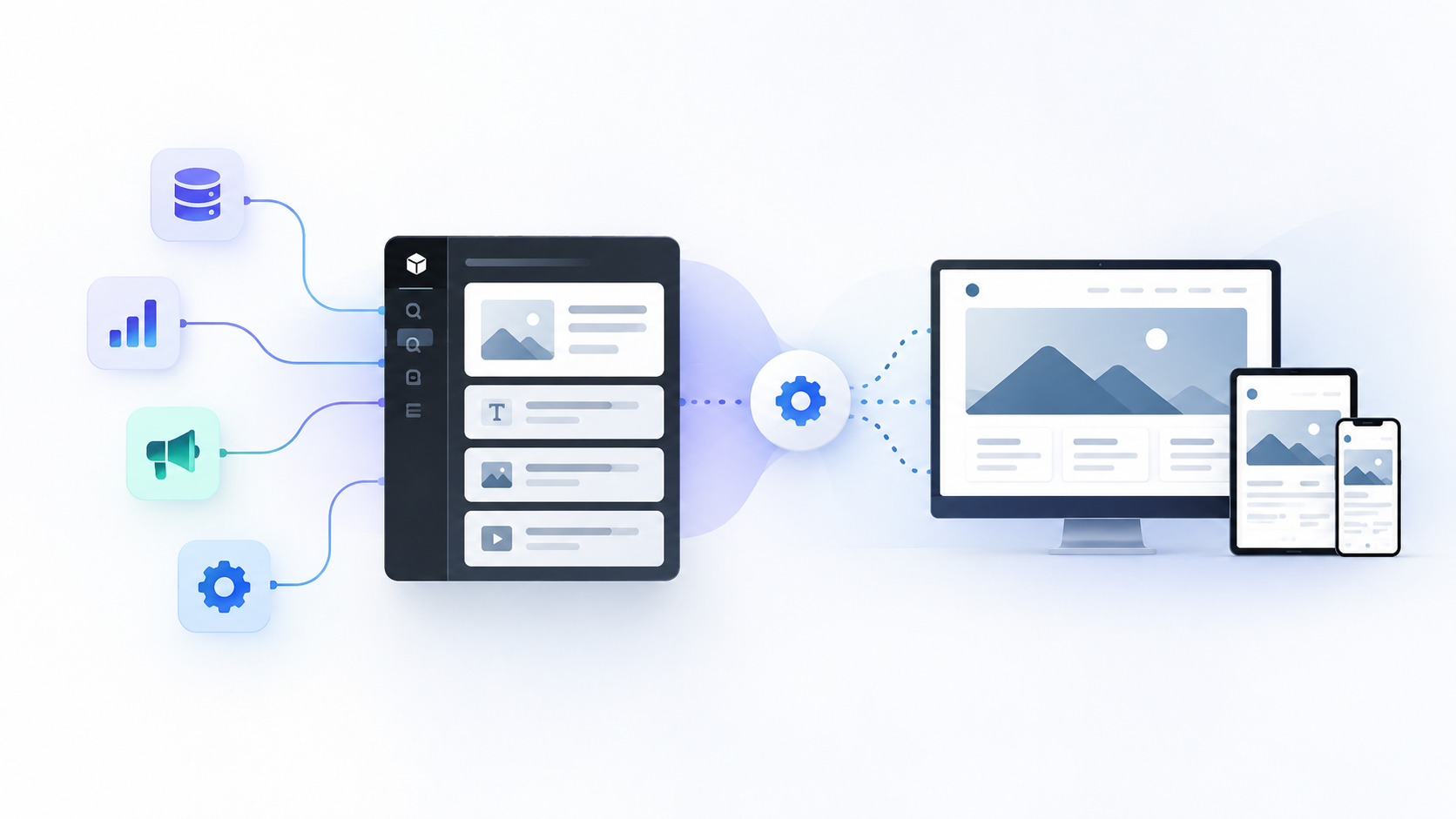
The best CRM website data integration agency is the one that can connect your website, CRM, and marketing systems into a single working data architecture, not just link two tools together.
TL;DR
- Website, CMS, and CRM data drift apart as B2B teams grow, which makes basic RevOps questions hard to answer.
- The right CRM consulting and implementation agency depends on your tech stack, how custom the integration is, and what your internal team can own.
- Look for agencies that cover CRM customization, development and integrations, migration, and CMS work together, not in separate silos.
- Computan, SmartBug Media, Open Flow, New Target, and Perficient each fit a different type of project.
- Cost depends on drivers like number of systems, sync direction, API availability, and data cleanup, so avoid any agency that quotes one universal price.
- Measure success by business outcomes such as lead attribution and sales follow-up speed, not by successful API calls alone.
Why Website, CMS, and CRM Data Keep Drifting Apart
As B2B organizations grow, the tools multiply. Website activity lives in the CMS or analytics platform. Lead and customer records live in the CRM. Campaign and engagement data lives somewhere else. Research from MuleSoft found that the average organization uses 897 applications, and 66% of respondents still do not deliver an integrated user experience across their channels.[1] In an earlier edition of that research, 80% of respondents said integration issues lead to data silos,[2] and the share of applications that are actually integrated had hovered around 29% for several years.[3]
That gap makes the most basic RevOps questions hard to answer. Where did this lead come from? What did they interact with before they filled out the form? Who should sales follow up with today? Gartner estimates that poor data quality costs organizations an average of $12.9 million every year,[4] and disconnected systems are one of the fastest ways to create it.
This is where CRM consulting and implementation agencies come in. The best ones connect your CMS, CRM, and marketing platforms so the data is usable by marketing, sales, and RevOps. Which agency is best for you depends on the complexity of the integration, your existing tech stack, how much customization you need, and the resources you have in-house.
What Is CRM Website Data Integration?
CRM website data integration is the process of connecting your website and CMS activity to your CRM records so every team works from the same view of a prospect or customer. In practice, that usually includes:
- Connecting website and CMS activity with CRM records.
- Passing form submissions and lead data into the CRM.
- Tying website behavior to contact and company records.
- Syncing marketing and sales data in both directions.
- Connecting third-party platforms through APIs, middleware, or native integrations.
- Creating a unified view of customer and prospect activity.
The goal is not simply to "connect two systems." It is to make data usable across marketing, sales, and RevOps.
What Should You Look for in a CRM Integration Agency?
Before comparing names, decide what you are actually evaluating. These are the criteria we use throughout this guide, and we apply them to every agency on the list.
1. CRM Consulting and Implementation Experience
- Experience with the major CRM platforms.
- Ability to audit your existing CRM before recommending changes.
- Hands-on CRM configuration and implementation experience.
2. CRM Customization
- Custom properties and custom objects.
- Custom workflows and automation.
- Custom reporting and dashboards.
- CRM architecture tailored to your business processes, not a default setup.
3. CRM Development and Integrations
- API development.
- Middleware.
- Webhooks.
- Custom connectors.
- Integration between the CRM, CMS, marketing platforms, and other business systems.
Be careful with partner tiers here. One agency analysis points out that a HubSpot partner tier reflects revenue generated for HubSpot, not development quality, and that real development means building custom objects, APIs, and middleware that native tools cannot deliver.[5]
4. CMS and Website Development
- Ability to work on the website itself instead of treating it as a separate system.
- Experience with HubSpot CMS, WordPress, or your CMS of choice.
- Custom CMS development.
- Website forms, landing pages, and data capture.
5. Data Migration and Cleanup
- CRM migration.
- Deduplication.
- Field mapping.
- Data normalization.
- Historical data migration.
- Data validation.
6. RevOps and Marketing Operations Understanding
- Understanding how marketing, sales, and service data interact.
- Ability to design workflows around business processes, not just technical connections.
Best Agencies for CRM Website Data Integration
The table below compares five agencies against the same criteria. It is based on each agency's own published information and public listings, so confirm current services directly before you shortlist.
|
Agency |
CRM Expertise |
Integration Depth |
CMS/Web Development |
Migration |
Custom Development |
Best For |
|---|---|---|---|---|---|---|
|
Computan |
HubSpot CRM consulting and implementation |
HubSpot integrations with platforms such as Salesforce, Shopify, NetSuite, Stripe, and custom ERPs |
HubSpot CMS, WordPress, Shopify |
HubSpot migration, including WordPress to HubSpot CMS |
Custom APIs, middleware, apps, white-label development |
B2B teams and agencies needing CRM integration plus website development |
|
SmartBug Media |
HubSpot Elite Solutions Partner with CRM implementation accreditation |
Marketplace integrations plus custom builds |
HubSpot CMS websites |
HubSpot data migration accredited |
Custom integrations through its Globalia development team |
Mid-market and enterprise teams wanting one full-service HubSpot agency |
|
Open Flow |
HubSpot Elite partner |
Custom API integrations to ERPs, ecommerce, and industry tools |
Website development service |
Mapping, cleanup, and validation methodology |
Custom API integrations after a discovery phase |
Mid-market and enterprise HubSpot integration projects |
|
New Target |
Salesforce services and data model design |
Salesforce connected to WordPress, Drupal, and ecommerce |
WordPress, Drupal, WooCommerce |
Not a headline service |
Custom website and integration builds |
Salesforce users with nonprofit, association, brand, or government websites |
|
Perficient |
Salesforce Summit Partner |
Enterprise integration, including MuleSoft experience |
Enterprise CMS work such as Sitecore |
Part of larger transformation programs |
Large-scale custom engineering |
Fortune 1000 organizations on Salesforce |
[6][7][8][9][10][11][12][13][14][15]
1. Computan
Computan sits at the intersection of CRM, CMS, custom development, and integrations. It is a Canada-based web development and HubSpot solutions company that works with marketing agencies, ecommerce businesses, and in-house marketing teams.[6] The team is made up of developers who build for marketers, which matters when the integration problem lives in the website as much as the CRM.[7]
What Computan covers:
- CRM consulting and implementation: HubSpot CRM consulting and setup.[6]
- HubSpot development and integrations: building and repairing integrations between HubSpot and platforms like Salesforce, Shopify, NetSuite, Stripe, Zapier, and custom ERPs.[6]
- WordPress and HubSpot CMS development: custom themes, templates, landing pages, modules, and WordPress and HubSpot integrations.[6]
- Custom API integrations, middleware, and automation: for cases where a standard connector is not enough.
- CRM customization: custom properties, objects, workflows, and reporting built around your process.
- CRM migration: including full migrations from WordPress to HubSpot CMS.[6][7]
- Website-to-CRM data workflows: forms, landing pages, and data capture that land clean in the CRM.
- White-label development for agencies: Computan works behind the scenes as a confidential technical partner for agencies.[6]
Best for: B2B companies and marketing operations teams that need both CRM integration and website or CMS development, particularly when standard integrations are not enough.
Worth considering: Computan's core platforms are HubSpot, WordPress, and Shopify. If your CRM is a different platform entirely, confirm fit during scoping.
Need to connect your CRM, website, and marketing systems? Talk to Computan about your integration requirements.
2. SmartBug Media
SmartBug Media is a full-service HubSpot agency and a three-time HubSpot North America Partner of the Year. Its listing states that implementation and integration work is backed by the technical development team at Globalia, a SmartBug division.[8] Public partner listings describe it as a HubSpot Elite Solutions Partner holding accreditations in CRM implementation, custom integration, and data migration.[9]
- Core CRM capabilities: CRM implementation, onboarding, platform enablement, and solutions architecture.[9]
- Primary platform: HubSpot.
- Integration strengths: configuration of marketplace integrations, with custom builds when the app you need is not available.[10]
- Website and CMS: website development is among its listed services.[8]
- Best fit: mid-market and enterprise teams that want strategy, marketing, and integration under one roof.
- Considerations: as a large full-service agency, confirm which team members will own the integration build and how long they stay on the account.
3. Open Flow
Open Flow is a HubSpot Elite partner that positions custom integrations and migrations as core services, alongside website development. According to its own published material, it has completed more than 100 integrations and over 450 onboardings, and its migration approach includes data mapping, cleanup, and validation steps.[11] These figures are self-reported, so ask for references.
- Core CRM capabilities: HubSpot onboarding, implementation, migration, and ongoing support.[11]
- Primary platform: HubSpot.
- Integration strengths: custom API integrations that connect HubSpot to ERPs, ecommerce platforms, and specialized industry tools.[11]
- Website and CMS: website development and creative services are offered alongside CRM work.[11]
- Best fit: mid-market and enterprise companies running complex HubSpot integration or Salesforce-to-HubSpot migration projects.
- Considerations: its own materials note a US focus and a discovery phase before custom integration scoping, which adds time up front.[11]
4. New Target
New Target approaches the problem from the website side. Its Salesforce services focus on connecting Salesforce to WordPress, Drupal, and ecommerce, including data model design, integrations, and personalization.[12] Its team combines UX designers, website developers, digital marketers, and Salesforce certified architects.[12]
- Core CRM capabilities: Salesforce data model design and integration services.[12]
- Primary platforms: Salesforce, WordPress, Drupal, WooCommerce.
- Integration strengths: website-to-Salesforce lead capture, personalization, and service workflows.[12]
- Website and CMS: a core strength, with WordPress and Drupal development, hosting, and support.[12]
- Best fit: nonprofits, associations, brands, and government teams that run Salesforce and need their website connected to it.[12]
- Considerations: its client mix skews toward nonprofits and associations, so ask about B2B SaaS or complex RevOps experience if that is your world.
5. Perficient
Perficient is a global systems integrator and a Salesforce Summit Partner, with a focus on Fortune 1000 organizations.[13] It has described integration expertise that includes MuleSoft,[14] and its published content shows a long history of enterprise CMS work, including Sitecore.[15]
- Core CRM capabilities: Salesforce implementation across CRM, data, AI, and personalization.[13]
- Primary platforms: Salesforce, MuleSoft, and enterprise CMS platforms.
- Integration strengths: enterprise-scale API-led integration.[14]
- Website and CMS: enterprise CMS experience, so confirm which platforms the current team supports.[15]
- Best fit: large enterprises with complex, multi-system Salesforce environments.
- Considerations: the scale and scope may be more than a mid-market marketing team needs for a focused website-to-CRM project.
How to Choose the Right CRM Integration Agency
A comparison table gets you to a shortlist. A decision framework gets you to the right partner.
1. Start With Your Existing Technology Stack
List everything the integration will touch:
- CRM
- CMS
- Marketing automation
- Analytics
- Ecommerce
- ERP and accounting
- Sales tools
- Data enrichment tools
The agency should understand the whole data ecosystem, not just the CRM.
2. Define What Data Needs to Move
Be specific about direction and purpose. Common examples include:
- Website form submissions to the CRM
- Website activity to the contact record
- CRM data to personalized website experiences
- Marketing engagement to sales alerts
- CRM properties to website workflows
- Offline data to the CRM
- Third-party application data to the CRM
3. Decide Whether You Need Native or Custom Integrations
A native or marketplace integration is usually enough when both systems already support the data flow you need and your rules are simple. You may need something more when you require:
- APIs, for systems with no ready-made connector
- Webhooks, so one system can notify another the moment something changes. HubSpot, for example, can send an HTTP request to an endpoint you configure whenever a subscribed CRM event happens, instead of making you poll for changes.[16]
- Middleware, to transform or route data between several systems
- Custom applications for unique business logic
- Custom connectors for legacy or internal platforms
4. Evaluate the Agency's Development Capabilities
Ask whether the agency can actually build what you need or only configure existing integrations. Ask to see past integrations similar to yours, and who on the team wrote the code.
Questions to Ask a CRM Integration Agency Before Hiring Them
- Which CRMs and CMS platforms do you specialize in? Depth in your platforms matters more than a long logo list.
- Have you integrated our CRM with our website? Ask for a comparable example.
- Can you work with APIs and custom integrations? Confirm there are developers on the team, not just configurators.
- How do you handle CRM migration? Listen for field mapping, testing, and validation steps.
- How do you approach data cleanup and deduplication? Bad data should be fixed before it is moved.
- Can you customize our CRM architecture? Custom objects and properties should follow your process.
- Can you build custom middleware if a native integration does not exist? This is the test of real development capacity.
- How will you handle failed or duplicate data? Every integration fails sometimes. The plan for failure matters.
- How will we monitor the integration after launch? Look for alerts, logs, and a named owner.
- Can your team support both the CRM and the website? One team avoids hand-off gaps.
- How do you document integrations? Documentation protects you if people change.
- Who owns the integration after implementation? Get this in writing, including code and credentials.
Common CRM Website Integration Mistakes
- Treating the CRM and website as separate projects. Forms, tracking, and data capture live on the site, so the two have to be planned together.
- Installing too many point-to-point integrations. Every new connection is one more thing to maintain and one more place data can break.
- Moving bad data into the new system. A migration is the best moment to clean up, not to copy problems across.
- Failing to define a source of truth. If two systems can both overwrite a field, someone has to decide which one wins.
- Not mapping fields before migration. Unmapped fields turn into lost history.
- Ignoring duplicate records. Duplicates split a single buyer's story across several contacts.
- Building automation before fixing CRM data. Automation on messy data just spreads the mess faster.
- Failing to track integration errors. Silent failures are the most expensive kind.
- Creating workflows nobody owns. Every workflow needs an owner who knows why it exists.
- Measuring integration activity instead of business outcomes. A successful sync is not the same as a better pipeline.
Most of these come down to the same root cause: integration, development, and RevOps strategy were handled by different people who never compared notes.
When You Need Custom CRM Development Instead of a Standard Integration
Not every project needs custom code, but some cannot work without it. It helps to know the four levels:
- Native integration: a built-in connection between two platforms, switched on and mapped.
- Configured integration: a marketplace app or connector set up with custom field mapping and rules.
- Custom API integration: code that talks directly to the APIs of your systems to move data your way.
- Custom application or middleware: a purpose-built layer that sits between systems to transform, validate, and route data.
Signs you have moved past a standard integration:
- Complex data transformations between systems.
- Multiple systems that must stay synchronized.
- Legacy platforms with limited or no APIs.
- Custom CRM objects that standard connectors do not support. In HubSpot, for instance, generic webhook subscriptions for custom objects are limited to private apps.[17]
- Unique business rules, such as routing or scoring logic.
- Two-way synchronization where conflicts have to be resolved.
- Real-time data requirements.
- Custom website experiences driven by CRM data.
How Much Does CRM Website Integration Cost?
There is no single universal price, and any agency that quotes one before understanding your stack should raise a flag. Cost depends on drivers like these:
- Number of systems: every added platform adds mapping, testing, and maintenance.
- CRM complexity: custom objects, many pipelines, and heavy customization raise scope.
- Number of data objects: contacts alone are simple. Contacts, companies, deals, tickets, and custom objects are not.
- One-way vs. two-way sync: two-way sync needs conflict rules and more testing.
- API availability: well-documented APIs are faster to build against than closed or legacy systems.
- Migration requirements: volume of records, years of history, and field mapping all matter.
- Data cleanup: deduplication and normalization can take longer than the integration itself.
- Custom development: middleware and custom applications cost more than configured connectors.
- Testing and ongoing support: monitoring, error handling, and maintenance continue after launch.
Timelines follow the same logic. One HubSpot partner estimates that simple two-system integrations can take a few weeks, while multi-source projects with custom objects and two-way syncs can take a few months.[11] Treat that as a rough guide, not a quote, and ask each agency for a scoped estimate after discovery.
Final Checklist: Choosing a CRM Website Integration Partner
- ☐ Understands your CRM
- ☐ Understands your CMS
- ☐ Can handle custom development
- ☐ Has API and integration expertise
- ☐ Can migrate and clean data
- ☐ Understands B2B marketing operations
- ☐ Can work across marketing and sales systems
- ☐ Provides documentation
- ☐ Has a post-launch support process
- ☐ Measures business outcomes, not just successful API calls
Final Thoughts
The best CRM integration agency is not necessarily the one with the longest list of integrations. It is the one that understands how your website, CRM, marketing systems, and sales processes work together, and can build the data architecture that makes them operate as one system.
That is the thinking behind Computan's work: CRM consulting and implementation, CRM customization, CRM development and integrations, CRM migration, HubSpot development, WordPress and HubSpot CMS, and custom integrations and middleware, all from a team that builds for marketers.
Looking for a partner to connect your CRM, CMS, and marketing technology stack? Talk to Computan about your integration project.
Sources
[1] MuleSoft: 2025 Connectivity Benchmark Report
[2] ITPro Today: MuleSoft Connectivity Benchmark Report Details Integration Challenges
[3] Salesforce DevOps: Integration and Silos as Top Challenges for Enterprise IT
[4] Verato: Gartner Data Quality Research Summary
[5] RaftLabs: Top HubSpot Development Companies
[6] Clutch: Computan Company Profile and Services
[7] Computan: Developers for Marketers
[8] HubSpot Solutions Directory: SmartBug Media
[9] Apollo.io Certified Partners: SmartBug Media
[10] SmartBug Media: HubSpot Integrations
[11] Open Flow: 7 HubSpot Partners for Custom CRM Integrations in 2026
[12] New Target: Salesforce Services
[13] Perficient: Salesforce Alliance
[14] Perficient: Strengthening Our Salesforce Capabilities with Sundog Interactive
[15] Perficient Blogs: CMS Posts
[16] HubSpot Developers: Webhooks API Guide
[17] HubSpot Developers: Create Generic Webhook Subscriptions
Frequently Asked Questions
What is CRM website data integration?
It is the process of connecting your website and CMS activity, such as form submissions and page behavior, to your CRM records so marketing, sales, and RevOps work from the same data.
What should I look for in a CRM consulting and implementation agency?
Look for CRM implementation experience, CRM customization skills, API and integration development, CMS and website capability, migration and data cleanup, and an understanding of B2B marketing operations.
Do I need a custom integration or will a native integration work?
A native or marketplace integration often works when both systems support your data flow and your rules are simple. You likely need custom work when you have legacy platforms, custom objects, two-way sync, real-time needs, or complex transformation rules.
How much does CRM website integration cost?
There is no single price. Cost depends on the number of systems, CRM complexity, number of data objects, sync direction, API availability, migration and cleanup needs, custom development, and ongoing support.
How long does a CRM website integration take?
Simple two-system integrations can take a few weeks, while projects with multiple data sources, custom objects, and two-way sync can take a few months. A discovery phase gives you a more accurate estimate.
What is the difference between a CRM integration and a CRM migration?
An integration connects systems so data flows between them. A migration moves data from one system to another, usually with field mapping, cleanup, and validation. Many projects need both.
Can one agency handle both the CRM and the website?
Yes, and it often works better. Agencies that cover both avoid hand-off gaps, because forms, tracking, and data capture live on the website while the records live in the CRM.
How do I measure whether the integration worked?
Measure business outcomes: lead source accuracy, speed of sales follow-up, duplicate rate, and reporting you trust. A successful API call only proves data moved, not that it was useful.