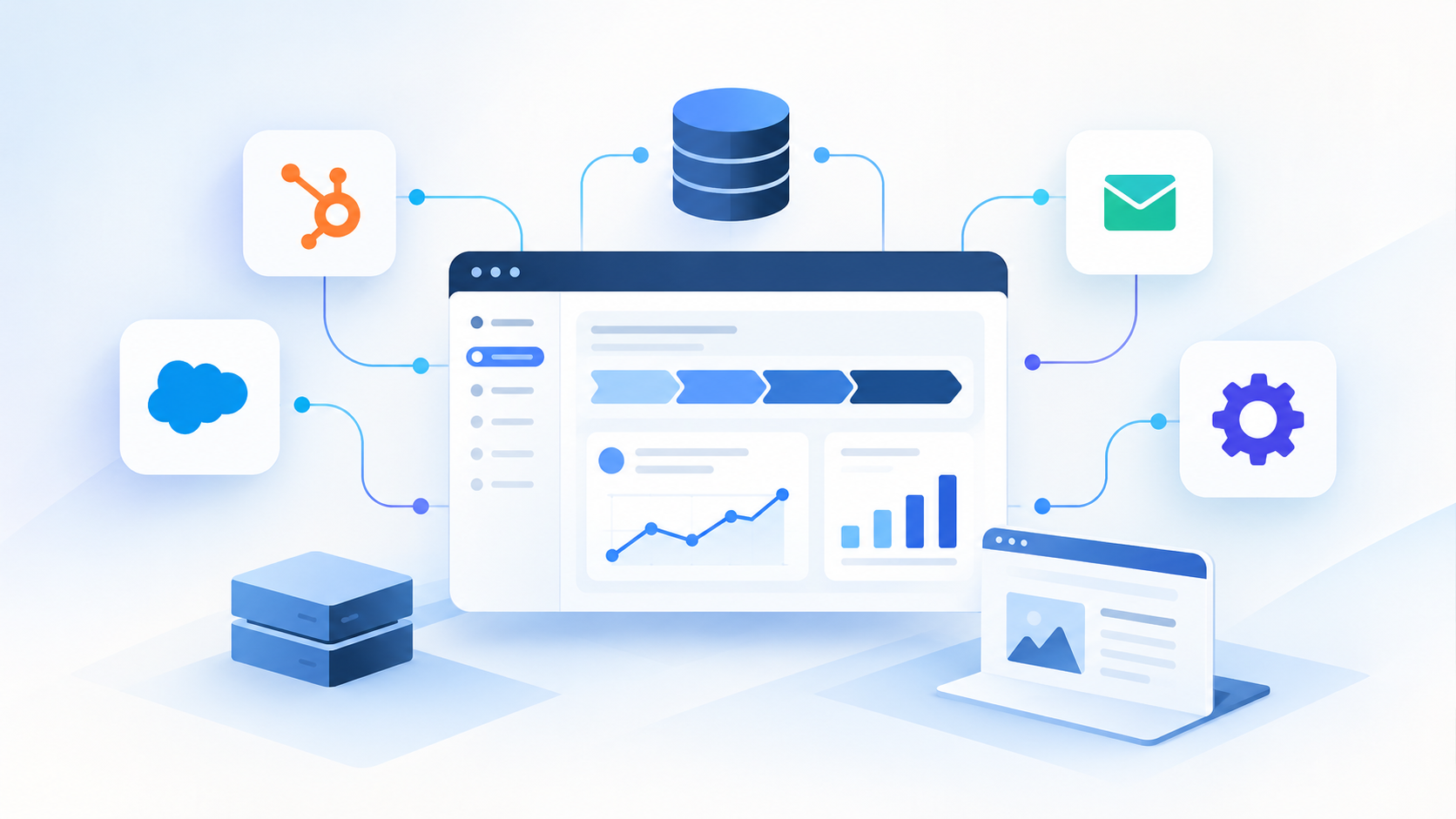
The best CMS agency for a headless marketing website is the one that treats your site as part of your revenue engine, not a standalone build that happens to have an API.
TL;DR
- Picking a CMS development agency is an architecture decision, so compare architecture, integrations, and migration skill, not just portfolios and hourly rates.
- Headless CMS gives you frontend freedom and performance control, but it does not make a site fast on its own. Implementation quality decides the result.
- Evaluate agencies on eight things: headless expertise, frontend performance, Core Web Vitals, marketing integrations, CRM connectivity, content modeling, migration, and ongoing support.
- A marketing website that cannot pass lead data into your CRM is not a complete marketing website.
- A CMS migration should protect your SEO equity through URL mapping and clean one-hop 301 redirects.
- Match the agency type to your need: headless specialist, enterprise integrator, publishing specialist, or CRM-connected marketing partner.
Why Choosing a CMS Agency Is Really an Architecture Decision
Let's be honest. Most agency comparisons come down to a portfolio scroll and an hourly rate. That works fine when you are picking someone to design a logo. It is a risky way to pick the team that will decide how your content is modeled, how your pages render, and whether a form fill ever reaches your CRM.
Headless CMS has gone mainstream for good reasons. WP Engine's State of Headless 2024 report found that 80% of the IT and marketing professionals it surveyed believe headless enables efficient content reuse across channels.[1] A statistics roundup from Storyblok, itself a headless vendor, says about 25% of businesses use a headless CMS and that 61% of companies reported higher ROI after migrating. Because that data is vendor-published, treat it as directional rather than gospel.[2]
The companies that lean toward headless usually need some mix of the following:
- Flexible content management
- High-performance websites
- Reusable components
- Multiple integrations
- Scalable landing pages
- Strong SEO and AEO foundations
An agency that builds websites can hand you a nice-looking frontend. An agency that can architect a marketing platform asks harder questions up front: where does content live, how do marketers publish it, what happens to the lead after the form fill, and who owns the performance budget six months after launch?
To keep this comparison honest, we scored every agency against the same eight criteria:
- Headless CMS expertise
- Frontend performance
- Core Web Vitals
- Marketing integrations
- CRM connectivity
- Content modeling
- Migration capabilities
- Ongoing development and support
Here is the idea we keep coming back to at Computan: the best CMS development agencies do not treat the website as an isolated asset. They build it as one part of the client's broader marketing and revenue ecosystem. If you want the wider view, our guides on integrated marketing websites and CRM and CMS agencies for B2B teams cover the same theme from other angles.
What Makes a Strong CMS Development Agency?
Before comparing names, decide what you are actually evaluating. These four areas separate a capable CMS partner from a template shop.
1. CMS and architecture expertise
- A real understanding of traditional versus headless CMS, and when a decoupled architecture makes sense
- The ability to work across platforms instead of forcing one CMS onto every project
Be a little suspicious of any agency that recommends the same platform for every client. The right answer depends on your team, your content, and your stack.
2. Frontend engineering capabilities
- Modern frameworks and component-based development
- Reusable design systems and responsive architecture
- A clear rendering strategy (static, server-side, or a mix)
3. Marketing team usability
HubSpot's own developer team makes a point worth repeating: many content management systems serve one persona really well, but very few work for both developers and marketers.[3] Ask the agency to prove your marketers will not need a ticket to publish a page:
- Can marketers create and update pages without developers?
- Reusable modules and flexible content models
- Landing page creation and approval workflows
- Multi-region and multi-language content
4. Integration capabilities
A strong agency understands how the CMS connects with your CRM, marketing automation, analytics, forms, lead scoring, personalization, search, and third-party APIs. A headless setup paired with a fully integrated platform also helps teams collaborate on content strategy tied to department goals.[4] This is where integrated marketing websites separate themselves from ordinary CMS projects.
Headless CMS vs. Traditional CMS: Which Should You Choose?
Headless is not automatically better. The useful question is not "Is headless better?" It is this: does your business actually benefit from separating content management from presentation?
| Factor | Traditional CMS | Headless CMS |
|---|---|---|
| Best for | Content-heavy sites, smaller marketing teams, straightforward publishing, everything in one platform | Complex content ecosystems, multiple frontend experiences, custom web applications, large marketing teams |
| Frontend control | Shared with the CMS and its templates | Full control over framework and rendering |
| Performance control | Shared with the CMS core and plugins | You own it, for better or worse |
| Speed to launch | Faster | Slower, because the frontend is custom |
| Operational overhead | Lower | Higher, with more moving parts |
| Multi-channel publishing | Limited | Built for it |
One developer-focused comparison sums it up neatly: go headless if you want performance control, and stick with traditional if you need speed to launch.[8]
The trade-offs, plainly
- Flexibility vs. complexity. Headless gives developers the freedom to choose their own frameworks, but someone has to build and maintain the frontend. One 2026 cost breakdown for a mid-market corporate site estimates headless adds 15 to 25% to the build budget, while making future changes cheaper.[9]
- Performance potential vs. implementation quality. It is possible to build a fast site on a monolithic CMS and a slow one on a headless CMS. Headless paired with a performance-optimized framework tends to give the best results.[5] Static generation, edge caching, and modern image formats are the levers.[6]
- Developer control vs. operational overhead. More control means more responsibility for caching, rendering, and monitoring.
- Scalability vs. governance. Headless scales across channels and regions, but it needs clear content models and approval workflows to stay tidy.
The SEO story follows the same pattern. Headless can be better for SEO when it is implemented with the right frontend architecture, structured data, internal linking, and technical optimization. The architecture alone is not the win.[7]
How We Evaluated the Best CMS Development Agencies
This is the part most "best agencies" lists skip. We used a transparent framework. Score each agency from 1 to 5 in every row, and the total out of 50 gives you a shortlist you can defend in a meeting.
| Evaluation area | What to look for |
|---|---|
| CMS expertise | Experience with modern and enterprise CMS platforms |
| Headless architecture | API-first architecture and decoupled frontend experience |
| Performance | Core Web Vitals, page speed, image optimization, caching |
| UX/UI | Design systems and conversion-focused UX |
| Marketing integration | CRM, automation, analytics, and third-party integrations |
| SEO | Technical SEO, structured data, redirects, metadata |
| Content operations | Flexible models and marketer-friendly editing |
| Development | Custom functionality and integrations |
| Migration | CMS migrations without losing SEO equity |
| Support | Post-launch optimization and maintenance |
Notice how much of this has nothing to do with the CMS itself. That is the point. CMS development is as much about integrations, SEO, and ongoing ownership as it is about the platform.
Best CMS Agencies for Headless Marketing Websites
We did not rank these from 1 to 10. A category-based view is more useful, because the "best" agency for an enterprise composable build is rarely the best agency for a CRM-connected marketing site. A quick note on transparency: Computan is one of the agencies on this list, so we kept every profile factual and based on public information. Verify details directly before you shortlist anyone.
1. Computan: Best for Integrated Marketing Websites and Custom CMS Development
Why it stands out
- CMS development plus custom web development under one roof
- HubSpot CMS themes, templates, landing pages, blogs, and drag-and-drop modules built for speed and marketer use[10]
- WordPress, HubSpot, Shopify, and custom PHP experience, plus WordPress-to-HubSpot migrations that preserve SEO, redirects, and content structure[10]
- Custom integrations and CRM-connected websites, with marketing automation in the loop
- White-label capability, and a stated willingness to work in whatever CMS the client is comfortable with[11]
- Support for agencies as well as internal marketing teams
Best for: marketing teams and agencies that need the website connected to their broader marketing technology stack.
Computan treats a website as more than a frontend. The way we see it, the real build looks like this:
CMS → Website → CRM → Marketing Automation → Analytics → Lead Management
Potential limitations: Computan is a development partner for marketers, and by its own description does not sell marketing services or inbound retainers.[11] If you want one vendor to also run your campaigns, look elsewhere. Teams that need a global systems integrator for a multi-brand program may also be better served by an enterprise firm. You can explore our HubSpot development, WordPress development, and white-label services pages for specifics.
2. FocusReactive: Best for Multi-Platform Headless Architecture
- Platforms: official partner status with Sanity, Storyblok, Contentful, and Payload CMS, plus a vendor-agnostic selection process according to one 2026 ranking[12]
- Typical project profile: organizations needing multi-platform headless architecture, content localization infrastructure, or editorial workflow design[13]
- Strengths: platform breadth and a proprietary CMS toolkit refined across many deployments[12]
- Worth confirming: how CRM and marketing automation work is scoped, since the public emphasis is on CMS engineering
3. Valtech: Best for Enterprise Composable Implementations
- Platforms: a deep Contentful practice, described as the most credible enterprise Contentful specialist in one comparison[14]
- Typical project profile: large, complex programs, including composable commerce builds where the CMS sits beside a commerce engine and a CRM[14]
- Strengths: enterprise scale and multi-system integration experience
- Worth confirming: budget and team-size fit. One buyer's guide puts enterprise CMS implementations at roughly $200,000 to $1M or more.[15]
4. 10up and Human Made: Best for Content-Heavy Organizations
- Platforms: WordPress at scale. 10up is described as a leading WordPress agency with a publisher and enterprise track record, and Human Made as an enterprise WordPress VIP partner with editorial and media depth[15]
- Typical project profile: publishers, media organizations, and large editorial teams
- Strengths: editorial experience and high-volume publishing
- Worth confirming: how they approach a fully decoupled frontend if you need one
5. Lullabot: Best for Decoupled Drupal and Enterprise Content Architecture
- Platforms: Drupal and decoupled CMS architecture[15]
- Typical project profile: complex content ecosystems with heavy governance needs
- Strengths: deep architecture and open-source experience
- Worth confirming: fit if your team lives in a marketing platform like HubSpot rather than a developer-led stack
6. Anything Agency: Best for Teams Committed to Storyblok
- Platforms: Storyblok. The agency built its practice around that one platform[13]
- Typical project profile: marketing-led headless builds on a chosen platform
- Strengths: focus and depth on a single CMS
- Worth confirming: how objective the platform advice is if Storyblok turns out not to be the right fit
CMS agency comparison at a glance
| Agency | Best for | Platforms named publicly | Headless focus | CRM and marketing integration emphasis |
|---|---|---|---|---|
| Computan | Integrated marketing websites | HubSpot CMS, WordPress, Shopify, custom PHP | Yes, when the project calls for it | Core focus (HubSpot, custom integrations) |
| FocusReactive | Multi-platform headless | Sanity, Storyblok, Contentful, Payload | Core focus | Not highlighted in sources reviewed |
| Valtech | Enterprise composable programs | Contentful and others | Core to its Contentful work | CRM included in composable builds |
| 10up / Human Made | Content-heavy publishing | WordPress | Not the headline focus in sources reviewed | Not highlighted in sources reviewed |
| Lullabot | Enterprise content architecture | Drupal | Decoupled architecture is a stated specialty | Not highlighted in sources reviewed |
| Anything Agency | Storyblok-centric builds | Storyblok | Core focus | Not highlighted in sources reviewed |
This table reflects public positioning at the time of writing, not a performance audit of any agency's work.[12][13][14][15]
What to Look for in a Headless CMS Agency's Portfolio
Do not just look at screenshots. Look for evidence of the following.
- Performance: Core Web Vitals (LCP, INP, CLS) and mobile performance[16]
- Architecture: headless CMS use, API integrations, the frontend framework, and reusable components
- Marketing: CRM integrations, marketing automation, forms, analytics, and personalization
- Content: structured content models, reusable modules, landing pages, case studies, and blog architecture
- Scalability: multiple business units, regions, languages, and large content libraries
Core Web Vitals: What Should You Actually Ask an Agency?
Core Web Vitals are three field metrics: Largest Contentful Paint (loading), Interaction to Next Paint (responsiveness), and Cumulative Layout Shift (visual stability).[16] The "good" targets are an LCP under 2.5 seconds, an INP under 200 milliseconds, and a CLS under 0.1, measured at the 75th percentile of real visitors. INP replaced First Input Delay in March 2024 and is far stricter, and JavaScript is usually what decides it.[17]
Ask every agency on your shortlist:
- How do you measure Core Web Vitals?
- Do you use real-user data or only Lighthouse?
- What is your LCP target?
- How do you control JavaScript?
- How are images delivered?
- How does the CMS affect rendering?
- What happens when marketers add new content?
- Do you establish performance budgets?
- How do you prevent performance regressions after launch?
The real-user question matters. Lab tools like Lighthouse give a quick audit, while real user monitoring captures diverse devices and networks, and a performance budget keeps the whole thing honest after launch.[8]
The important angle: a headless CMS does not automatically create a fast website. The frontend, JavaScript strategy, rendering approach, images, fonts, hosting, and third-party scripts all influence performance. Headless does give you the levers, such as static generation, edge caching, and modern image formats, and LCP is typically the hardest vital to get right.[6] Real-world data backs up the caution. In HTTP Archive's 2025 Web Almanac (July 2025 data), only 48% of mobile origins and 56% of desktop origins had good Core Web Vitals.[18] Google has also said Core Web Vitals are one part of page experience, not a single ranking switch, so the biggest payoff is usually the user experience itself.[18]
The Marketing Technology Stack Matters More Than the CMS
This is where many headless projects quietly fall short. A modern marketing website often needs to connect with:
- HubSpot and Salesforce
- Marketing automation and email platforms
- Google Analytics and Google Search Console
- CRM databases and lead enrichment platforms
- Chat tools, product databases, and other APIs
- Reporting platforms
A beautiful website that cannot pass lead data into the CRM is not a complete marketing website. A strong CMS agency understands the whole chain:
Visitor → Content → Conversion → CRM → Automation → Sales → Reporting
Here is a practical HubSpot example. Going headless replaces HubSpot's CMS layer, not the CRM, so you can keep using HubSpot's CRM and forms. What leaves with the CMS is HubSpot's built-in page tracking and smart content, which your agency needs to rebuild deliberately.[19] HubSpot can also act as a headless CMS in its own right, which is worth knowing before you add another platform to the stack.[4] This is exactly where an agency with real HubSpot integration experience earns its fee.
CMS Migration: Don't Just Move the Content
If you are replacing WordPress, Drupal, or another legacy CMS, check whether the agency understands migration beyond copying pages. A strong migration covers:
- Content migration and images or assets
- URL mapping and 301 redirects
- Metadata and structured data[20]
- Forms, integrations, and analytics
- Search rankings and performance
- QA and launch monitoring
The biggest risk in any CMS migration is losing hard-won search rankings, and HubSpot-to-headless moves are no exception.[19] The good news is that the rules are well documented. Every indexable old URL needs a single-hop 301 or 308 redirect at the server or edge. Google's site-move documentation says permanent redirects do not cause a loss in PageRank, but a full recrawl takes a few weeks or more, so expect ranking fluctuation along the way.[21] A redirect map is simply the spreadsheet that connects every old URL to its correct new URL, with a decision on 301, 404, or 410 and a QA status for each row, followed by about 90 days of recovery monitoring.[22]
The question to ask: what happens to our existing SEO equity when we move CMS platforms? If the answer does not start with a URL inventory, keep looking. Our HubSpot migration services are built around exactly that sequence.
Headless CMS Mistakes to Avoid
- Mistake 1: Choosing headless because it sounds faster. Architecture alone does not guarantee performance.[5]
- Mistake 2: Ignoring the editor experience. A technically sophisticated CMS that marketers hate becomes a bottleneck. One buyer's guide calls building for the development team instead of the content team the most expensive CMS mistake.[15]
- Mistake 3: Treating the website as a standalone project. The site should connect to the CRM, analytics, and the rest of the marketing stack.
- Mistake 4: Overengineering a simple website. Not every organization needs headless. Traditional is still the better fit for plenty of straightforward publishing needs.
- Mistake 5: Forgetting ongoing performance. A site can launch fast and slow down as scripts, apps, and content pile up. Plugin bloat and web fonts are classic culprits.[8]
- Mistake 6: Choosing an agency based only on design. Design matters, but architecture and integrations decide whether the site can scale.
How Much Does a Headless CMS Website Cost?
Instead of throwing out a number that will be wrong by next quarter, here are the factors that actually move the price:
- Number of templates and reusable components
- CMS complexity and platform licensing, since SaaS and self-hosted options price differently[23]
- Content migration
- Integrations and CRM requirements
- Localization and personalization
- Custom functionality
- Performance requirements
- Ongoing support
Unlike a traditional CMS theme, a headless site needs custom frontend development, which is usually the biggest line item.[23] It also helps to think in total cost of ownership. In one 2026 breakdown, ongoing operating costs made up 30 to 40% of the three-year total.[9]
This is why two agencies can quote wildly different prices for seemingly similar websites. Published ranges vary enormously. One guide says most full headless projects run $15,000 to $60,000,[13] while another puts enterprise CMS implementations at $200,000 to $1M or more.[15] The gap usually comes from differences in scope, integration depth, migration work, who builds the frontend, and whether support is included. Ask each agency to price the same scope, then compare line by line.
Questions to Ask Before Hiring a CMS Development Agency
- Which CMS platforms do you recommend and why?
- Do you build headless architectures?
- What frontend frameworks do you work with?
- How do you measure Core Web Vitals?
- Can marketers create landing pages without developers?
- How do you handle CRM integrations?
- Can you migrate our existing CMS?
- How do you preserve SEO during migration?
- How do you structure reusable components?
- What happens after launch?
- Who owns the code and infrastructure?
- Can you support ongoing optimization?
How to Choose the Right CMS Development Agency
The right answer is about fit, not a winner. Use this as a quick guide:
- Maximum frontend flexibility: consider a headless specialist.
- Complex enterprise content: prioritize CMS architecture and governance.
- A content-heavy publishing platform: prioritize editorial experience.
- A CRM-connected marketing website: prioritize integrations and marketing technology expertise.
- A website that needs to evolve with your marketing stack: choose an agency that handles both CMS development and integration work.
Building a new marketing website or considering a CMS migration? Computan can help you evaluate the architecture, CMS, integrations, and development requirements before you commit to a platform. Talk to our team.
Sources:
[1] HubSpot Blog: What Is a Headless CMS?
[2] Storyblok: CMS Statistics
[3] HubSpot Developers: What CMS Hub Means for Web Developers
[4] Huble: Is Headless CMS Right for Your Business?
[5] Storyblok: Headless vs. Monolithic CMS, Which Delivers Better Website Performance?
[6] Strapi: How Headless CMS Improves Website Speed and SEO Performance
[7] Publive: Headless CMS vs Traditional CMS
[8] DEV Community: Website and CMS, A Developer's Guide to Faster Page Rendering
[9] Kolonell: Corporate Website Cost Breakdown for SMBs in Berlin in 2026
[10] Clutch: Computan Company Profile
[11] Computan: Developers for Marketers
[12] GitNation: Top Headless CMS Agencies and Development Companies in 2026
[13] RaftLabs: Top Headless CMS Development Companies (July 2026 Update)
[14] eSEOspace: Best Contentful Development Agencies in 2026-2027
[15] RaftLabs: Top CMS Development Companies (July 2026 Edition)
[16] web.dev: How the Core Web Vitals Metrics Thresholds Were Defined
[17] G7Cloud: Core Web Vitals for WordPress, The 2026 Guide
[18] PPC Land: Core Web Vitals
[19] eSEOspace: Migrating from HubSpot CMS to a Headless CMS
[20] Naturaily: Headless CMS Complete Guide and SEO Strategies
[21] Strapi: How to Preserve SEO Rankings During a CMS Migration
[22] RankAI: Redirect Mapping and SEO-Safe Migration Checklist
[23] RWIT: How Much Does It Cost to Build a Headless CMS Website in 2026?
Frequently Asked Questions
What does a CMS development agency do?
A CMS development agency plans, builds, and maintains the content management system and website that power your marketing. That includes platform selection, content modeling, frontend development, integrations with tools like your CRM and analytics, migrations from older systems, and ongoing support.
What is a headless CMS?
A headless CMS stores and manages content in the back end and delivers it through APIs, leaving the presentation layer to your developers. Marketers manage content without touching code, while developers choose their own frontend frameworks.
Is a headless CMS better for SEO?
It can be, but not automatically. A headless setup helps when it is paired with a well-built frontend, structured data, strong internal linking, and technical optimization. A poorly implemented headless site can perform worse than a well-built traditional one.
Does headless CMS improve Core Web Vitals?
It gives you more control over the levers that affect them, such as static generation, edge caching, image delivery, and JavaScript. It does not guarantee good scores. Third-party scripts, fonts, hosting, and ongoing content changes can still hurt performance, so ask agencies how they measure and protect Core Web Vitals after launch.
How much does a headless CMS website cost?
It depends on the number of templates and components, CMS platform and licensing, content migration, integrations, CRM requirements, localization, personalization, custom functionality, performance requirements, and ongoing support. Published ranges vary widely, so ask every agency to price the same scope and compare line by line.
How do I choose the right CMS development agency?
Start with your needs rather than a ranking. Score shortlisted agencies on CMS expertise, headless architecture, performance, marketing integration, SEO, content operations, migration, and support. Then ask for proof in real projects, including Core Web Vitals data and migration results.
What is the difference between a CMS agency and a web development agency?
A web development agency focuses on building the site itself. A CMS agency also focuses on how content is modeled, published, governed, and connected to your wider stack, which matters most when marketers need to move quickly without developer help.
Can a headless CMS integrate with HubSpot and other CRMs?
Yes. A headless CMS can connect to HubSpot, Salesforce, and other CRMs through APIs and forms. When you go headless, HubSpot's CRM and forms can stay in place, but features tied to HubSpot's own CMS, such as built-in tracking and smart content, need to be rebuilt in the new setup.