Every agency says communication matters. Yet deadlines still slip. Feedback gets buried in Slack. Developers build exactly what was requested, only to hear, “That is not what we meant.”
Sound familiar?
The problem usually is not talent. It is not tools. And it is definitely not a lack of meetings. The real problem is workflow design.
After supporting agencies for years as a white-label development partner, we have seen the same communication breakdowns repeat across HubSpot projects, website builds, CMS migrations, and custom development.
The agencies that scale smoothly are not the ones with the most meetings. They are the ones with the clearest communication systems.
TL;DR
- More meetings rarely fix communication problems.
- Most agency delivery issues come from fragmented project information.
- A single source of truth reduces revisions, delays, and scope confusion.
- Async communication improves speed when expectations are documented.
- Clear handoffs, structured briefs, and ownership rules outperform daily check-ins.
The Real Cost of Broken Communication
According to PMI, poor communication is a contributing factor in project failure for nearly one-third of organizations [1].
In agency work, that cost shows up differently:
- Delayed launches
- Unplanned revision cycles
- Scope creep
- Client frustration
- Developer burnout
- Lower margins
One unclear request can create hours of rework across design, development, QA, and client approval.
Multiply that across multiple client accounts, and communication becomes either your biggest efficiency driver or your biggest operational leak.
Why More Meetings Usually Make It Worse
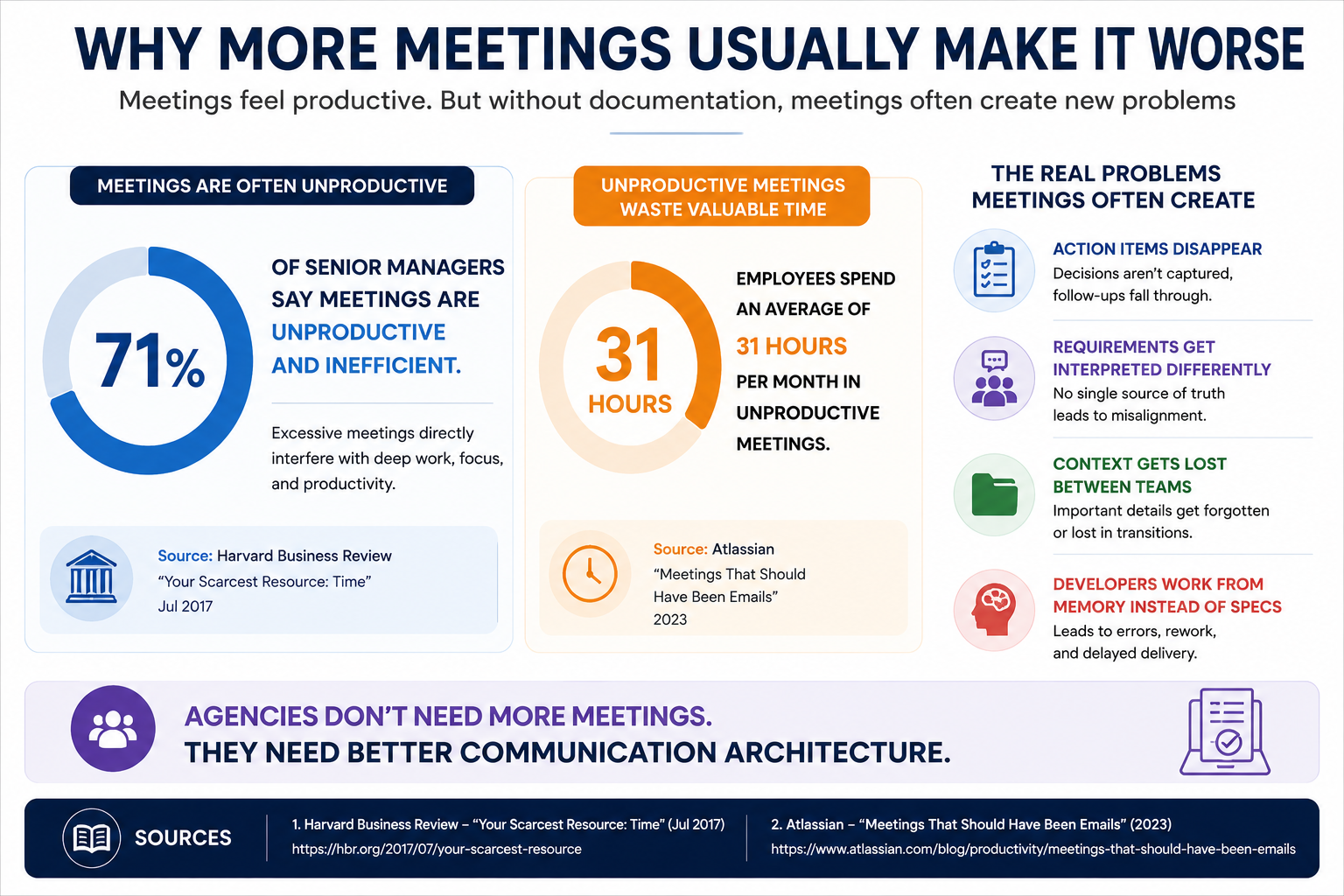
Meetings feel productive. But without documentation, meetings often create new problems:
- Action items disappear
- Requirements get interpreted differently
- Context gets lost between teams
- Developers work from memory instead of specifications
Harvard Business Review found that excessive meetings reduce productivity and increase employee fatigue [2].
Agencies do not need more meetings. They need better communication architecture.
The Computan Communication Framework
Here is the framework we see high-performing agencies use consistently.
1. Create One Source of Truth
Every project should have one primary system where all decisions live.
Examples:
- ClickUp
- Asana
- Jira
- HubSpot tickets
- Notion
Slack is for discussion. Project tools are for decisions. Mixing those two creates chaos.
2. Write Requirements Like Developers Will Never Join Your Meeting
Every ticket should answer:
- What are we building?
- Why does it matter?
- What does success look like?
- Are there examples?
- Who approves it?
According to Atlassian, teams with documented workflows complete work faster and with fewer blockers [3].
3. Use Async Video for Complex Feedback
Some feedback is too visual for text. Instead of a 30-minute call, record a 3-minute Loom.
This gives developers:
- Visual context
- Tone clarification
- Replayable instructions
- Fewer assumptions
Async communication also supports distributed teams across time zones [4].
4. Assign One Owner Per Decision
If everyone owns a task, nobody owns the outcome.
Every project needs:
- One project owner
- One approval owner
- One technical owner
Ownership removes ambiguity and speeds up approvals.
5. Define Handoff Rules Before Development Starts
Before a task reaches development, it should include:
- Approved design files
- Functional requirements
- Responsive behavior notes
- Asset links
- Client approvals
- Timeline expectations
Missing handoff criteria is one of the biggest sources of rework in agency delivery.
What Happens When Agencies Fix Communication
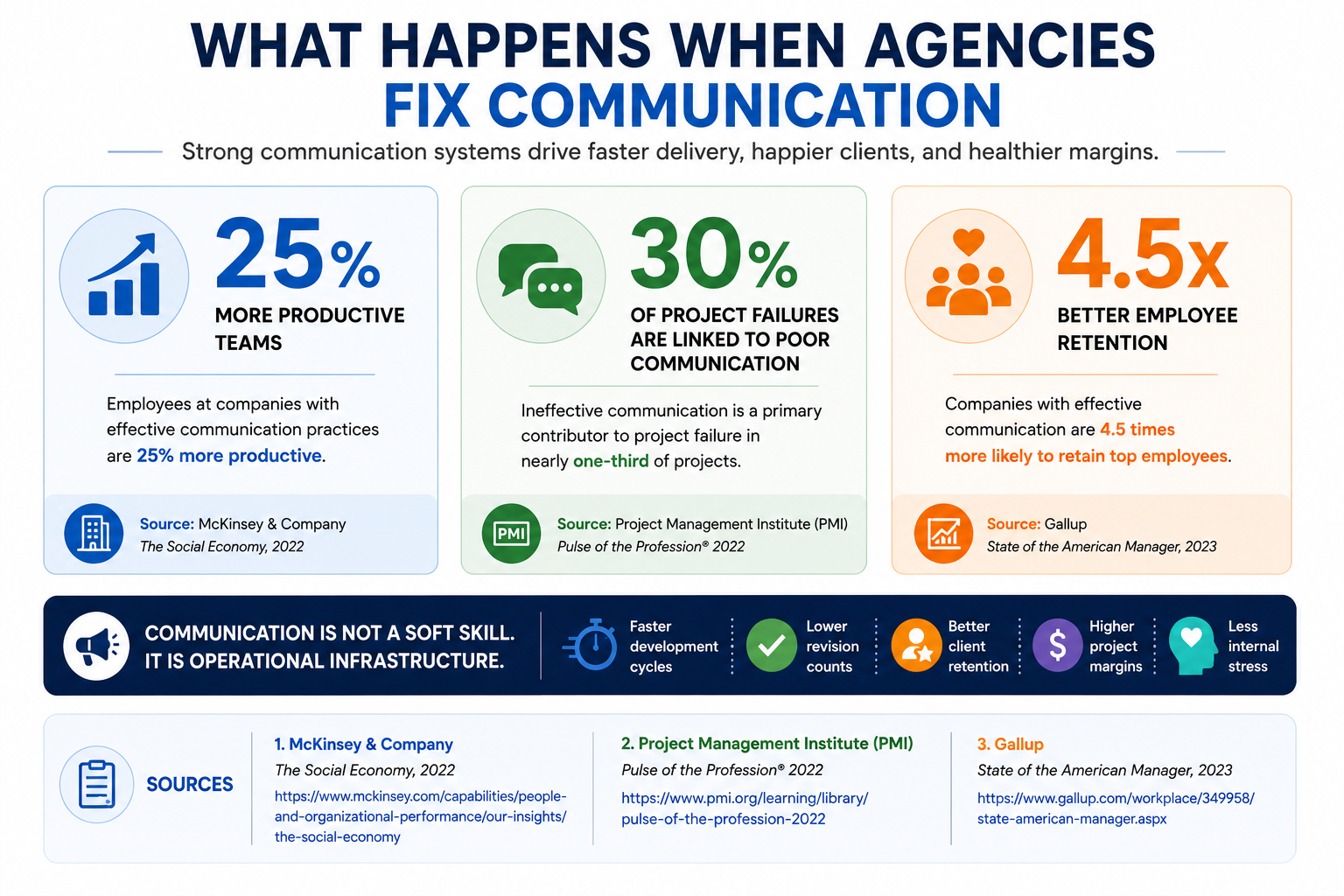
Agencies that improve communication systems typically see:
- Faster development cycles
- Lower revision counts
- Better client retention
- Higher project margins
- Less internal stress
Communication is not a soft skill. It is operational infrastructure.
Final Thought
If your agency is solving delivery issues by scheduling more calls, you may be treating the symptom instead of the cause.
Better communication does not come from talking more. It comes from documenting better, handing off cleaner, and building systems your developers can trust. That is how scalable agency delivery actually works.
Frequently Asked Questions
How many meetings should agencies have with development teams?
Only enough to align on strategy, priorities, and blockers. Execution should rely on documented workflows.
What is the best tool for agency to developer communication?
There is no universal tool. The best setup usually combines a project management platform, async video tools, and a centralized documentation system.
Why do agency projects experience scope creep?
Scope creep often happens when requirements are incomplete, approvals are undocumented, or ownership is unclear.
Can white-label development partners improve communication?
Yes. Experienced white-label partners often bring standardized workflows, documentation systems, and proven delivery processes.