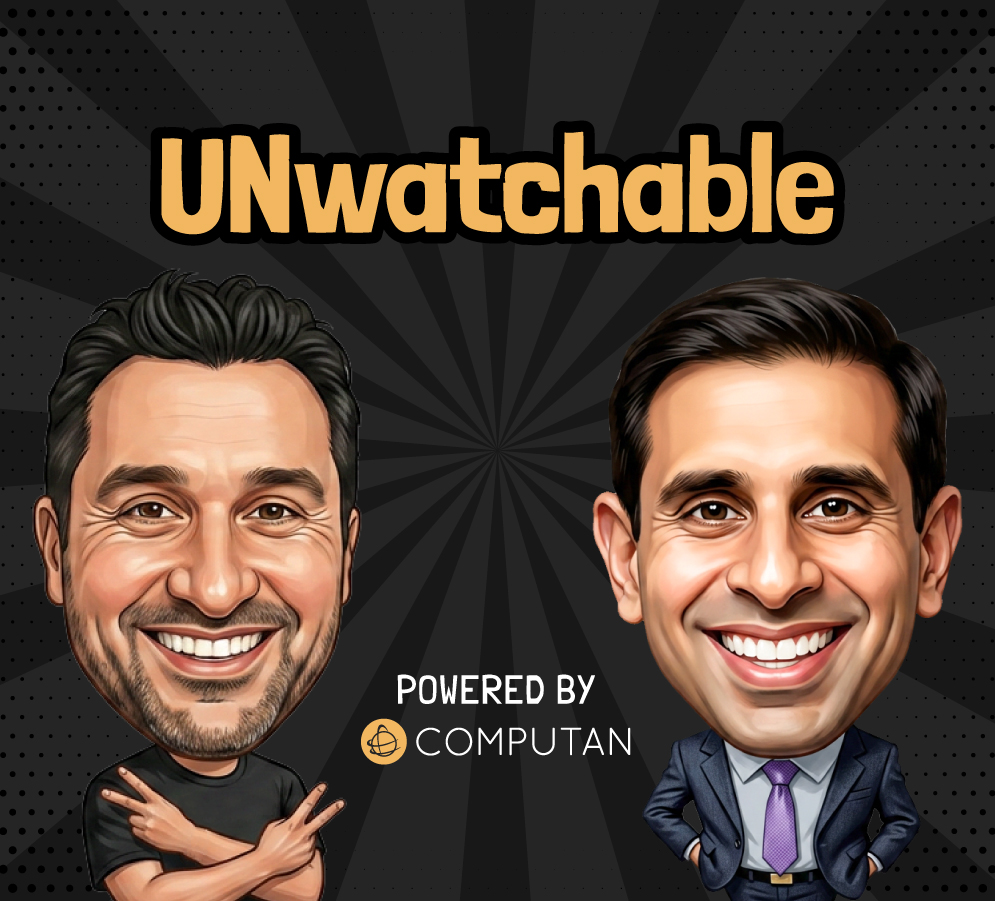

Joe hears “we only have one developer” and immediately starts calculating how much revenue that could cost you. As the resident reality check on AI, developers, and agency growth, Joe’s message is pretty simple: AI can write the code, but somebody still needs to know when the code is completely wrong.

Sajeel sees a client’s technical crisis and thinks, “Well, I guess we’re partners now.” From becoming the agency world’s “secret weapon” to arguing that AI still needs humans who know what they’re doing, Sajeel has a simple philosophy: don’t panic, build the right technical bench, and maybe teach the AI a thing or two.
Straight talk from a conversation between Sajeel Qureshi (CEO of Computan) and Joe "Triple J" Jerome (CRO, Computan) on the Unwatchable podcast.
TL;DR
- Sajeel Qureshi coined the phrase "developers for marketers" after a marketing agency client treated him more like a partner than a vendor on a custom WordPress project.
- Agencies still hit a wall when they only have one type of developer. A single HubSpot CMS developer cannot build WordPress or Shopify, which puts the entire client account at risk.
- Most agencies bring in outside technical help during a "911" moment, not as part of strategic planning, because agency life runs reactive and fast.
- AI has not killed the need for developers. It changed what developers do, the same way word processors changed how authors write without killing storytelling.
- AI still needs supervision. Structured code and integrations do not hallucinate. AI does.
- Agencies are slow to deploy AI operationally. HubSpot's new agent marketplace saw most agent listings get fewer than 10 installs despite roughly 7,000 agency partners.
- The advice for agency owners: lean into partnerships, and recognize you are more technical than you think.
Where the Phrase "Developers for Marketers" Actually Came From
Sajeel Qureshi traces the origin of "developers for marketers" back to an early Computan client, a marketing agency that had inherited a custom WordPress plugin project for a cemetery client. The deadline slipped, and instead of scrambling to cover it up, the agency owner turned to Sajeel directly.
Sajeel recalled the moment the relationship shifted from vendor to partner, saying
"a client was actually a partner of ours."That single project reframed how Computan approached agency work going forward. Instead of chasing one-off jobs, the company positioned itself as the technical bench an agency could quietly lean on.
Sajeel described the appeal of staying out of the spotlight this way:
"we kind of liked being the secret weapon."Since then, Computan has supported what Sajeel estimates at 300 to 400 agencies, ranging from solo operators to multinational firms.
Why Agencies Still Hit a Technical Wall
Joe Jerome, who ran Brand Builder Solutions before joining Computan, pointed to a specific and common failure pattern: agencies that only have one type of developer on staff.
- An agency with a single HubSpot CMS developer cannot build a WordPress site if the client insists on WordPress.
- Turning the client away to a second agency puts the entire retainer at risk, not just the website project.
- Joe put the stakes plainly:
"Your $10,000 a month strategic retainer is now in jeopardy."
- The same gap shows up with Shopify builds, custom integrations, and RevOps work, since HubSpot now functions as a full CRM and not just a marketing tool.
- Demand for developer time is rarely even. Agencies either overstaff and pay for idle capacity, or understaff and turn away work they could otherwise win.
Joe's take is that this gap directly costs agencies revenue:
"people are missing out on the revenue all over the place."
The "911" Pattern: Why Agencies Call Late, Not Early
Sajeel explained that most agencies do not come to Computan through strategic planning. They come during a crisis.
- A job is behind and the agency cannot finish it in time.
- A developer goes on leave and there is no backup coverage.
- The agency loses a technical hire with no replacement lined up.
Sajeel described his own default posture in these conversations:
"I'm more like the firefighter, not like the strategic person." He connected this directly to how agencies operate day to day, saying they are effectively "living in an inbox" with new jobs constantly arriving and staff spread thin.
Owners Think Differently Than Staff, and That Gap Slows Everything Down
One of the more pointed parts of the conversation covered why deals stall even when an agency owner is enthusiastic. Sajeel and Joe agreed that owners and staff are simply optimizing for different things.
Sajeel used a hospital analogy to make the point about wasted capacity:
"That's money lost. That's opportunity left on the table."
The idea: every hour a senior person spends on work a junior person could handle is an hour not spent on higher value work. Sajeel said this mindset tends to show up only at the most senior levels of an agency.
Joe connected this to compensation structure directly:
- Owners are paid on what hits the bottom line, so they are motivated to change how work gets done.
- Staff are often paid the same whether or not they adopt a new process, so there is little personal incentive to change.
- Project managers and department leads tend to ask operational questions ("how long, how much") rather than strategic ones.
- Deals that start with the founder or co-founder move faster than deals that start with a mid-level contact.
Sajeel summed up the founder mindset versus the staff mindset this way:
"Founder to founder, right?" The relationship changes entirely depending on who is actually in the room.
Has AI Actually Killed "Developers for Marketers"?
This was the central question of the episode, and both hosts landed in the same place: no, but the job is changing shape.
Sajeel drew a comparison to word processing software:
"Did Microsoft Word or Apple Pages kill authors?"
His point was that tools change how work gets produced without eliminating the need for the person who understands how to produce it well. He added a line that captures the whole argument:
"Technical people will always be in need."
What changes, according to Sajeel, is the nature of the problems technical people solve, not whether they are needed at all.
Joe brought the conversation back to practical reality with a direct example. Clients still come to Computan to rebuild Shopify stores and set up integrations rather than doing it themselves with AI tools. His reasoning:
- AI still makes mistakes and needs supervision.
- AI still hallucinates.
- Structured code, structured integrations, and structured queries behave predictably. AI, in Joe's words, has to be treated
"somewhat like working with a person."
Joe also pointed out that shortcuts have always existed in development, from Stack Overflow to code generators to autocomplete, and none of them eliminated developers. AI is simply the newest version of that same pattern.
What "Knowledge Architecture" Actually Means
Midway through the episode, the conversation shifted from whether developers are needed to what they should actually be building. Sajeel introduced the idea of "knowledge architecture," the underlying context, data structure, and governance that AI tools need before they can be useful.
Sajeel explained the logic simply:
"You need to educate the brain before the brain can think critically."
Joe connected this to real work Computan has been doing internally over the past several months, including:
- Connecting internal systems and data sources together
- Building custom AI skills and agentic workflows
- Certifying 15 team members as Claude partners
- Starting a new AI implementation partnership with Notion
Joe argued that setting up this kind of knowledge architecture is a legitimate, billable, high-value service category in its own right, not a side effect of using AI tools.
Why Most Agencies Are Slow to Actually Use AI
Despite all the hype, Sajeel was blunt about how little AI adoption has actually happened at the operational level inside agencies.
- Most agencies are still using AI only for front end, client facing content like blog posts or basic branding copy.
- Very few are using AI operationally for design QC, task management, or time tracking.
- Sajeel called using AI to build client strategy without human oversight
"a big red flag."
Joe backed this up with a concrete data point about HubSpot's new AI agent marketplace. Despite HubSpot having roughly a million users and around 7,000 agency partners, most listed agents had fewer than 10 installs. Joe's read on it:
"the adaptation is not there yet."
Both hosts compared this moment to the early 2010s, when inbound marketing and SaaS were new and traditional agencies struggled to adapt. Sajeel put it simply:
"people just don't know what they're going to do next."
Advice for Agency Owners Right Now
When Joe asked directly what advice Sajeel would give agency owners today, the answer was short and practical:
- Look to partnerships when scaling into something new instead of trying to build every capability in house.
- Recognize that your team is more technical than you think, and can offer more than you assume.
- Do not punt AI or technical projects entirely to staff. Owner involvement drives faster, more consistent results.
- Treat outside technical partners like you would treat onboarding a new employee, with real oversight and integration into the process.
Sajeel's closing line on the topic captured the overall stance of the episode:
"instead of doubling down with bad data, I'd rather change my mind."
Frequently Asked Questions
Is the "developers for marketers" model dead because of AI?
No. Both Sajeel Qureshi and Joe Jerome concluded that the underlying need for technical talent has not gone away. What has changed is the type of work developers do and the tools they use to do it, similar to how word processing software changed writing without eliminating the need for writers.
Why do agencies still need outside developers if they already have one on staff?
A single developer usually specializes in one platform, such as HubSpot CMS. When a client needs something outside that specialty, like WordPress or Shopify, the agency either has to turn the work away or bring in a second vendor, both of which put the client relationship and the retainer at risk.
What is "knowledge architecture" in an AI context?
Knowledge architecture refers to the context, data sources, rules, and governance an organization sets up so AI tools can work reliably. Without it, AI lacks the information it needs to produce accurate, useful output, which is why Sajeel Qureshi describes it as educating the brain before it can think critically.
Why are most agencies slow to adopt AI operationally?
According to Sajeel Qureshi, most agencies are still using AI only for surface level, client facing content creation. Very few have deployed it for internal operations like QC, task management, or time tracking, largely because the tools and workflows are still new and unfamiliar.
Why do agencies typically bring in outside technical help only during a crisis?
Agency work tends to be reactive by nature. Most outside technical engagements start with a specific, urgent problem, such as a missed deadline or a staffing gap, rather than as part of proactive strategic planning.
Does AI still need human supervision for development work?
Yes. Joe Jerome noted that AI still makes mistakes and hallucinates, which means it needs to be supervised similarly to a person. Structured code and integrations, by contrast, behave predictably and do not carry that same risk.