
He’s the guy who asks, “What’s the real problem here?” and, before everyone knows it, there’s a strategy, five workstreams, three verticals, and a Wednesday morning meeting on the calendar.

Sajeel’s job in a nutshell: open the door, start the conversation, and then let the team figure out what happens next.
Most CRMs are excellent at storing information and much weaker at turning that information into a clear daily action for a rep sitting down to start their day.
TL;DR
- A CRM full of contacts, emails, and website activity does not automatically tell a salesperson who to call today.
- Lead scores give a number. They rarely explain why that number matters or what to say when the rep picks up the phone.
- Marketing engagement signals like email opens are increasingly unreliable, and treating every click the same way hides real buying intent.
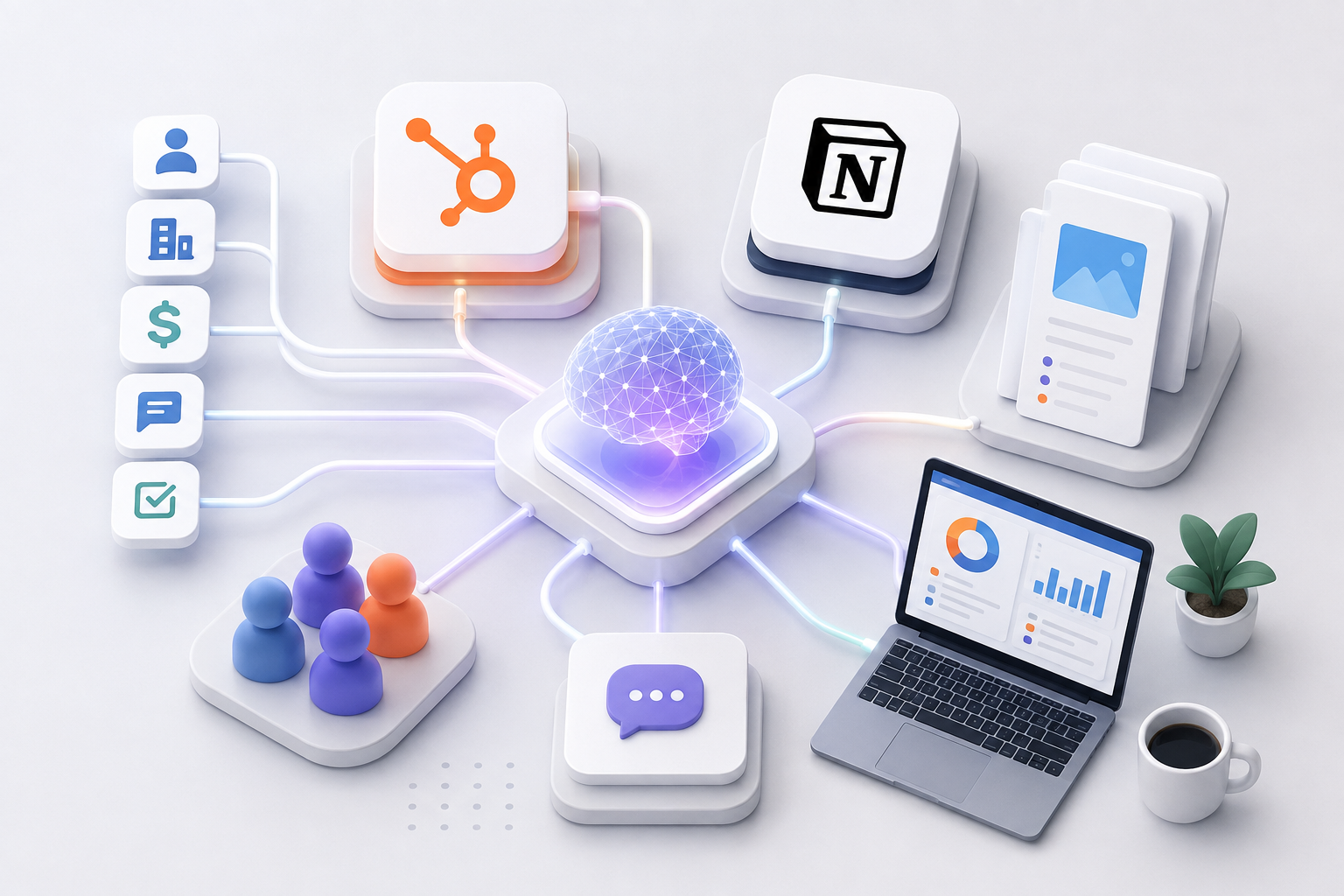
- An AI sales assistant sits across your existing CRM, email, and website data to answer one practical question: who should I call today, and why.
- AI does not replace the CRM. It makes the CRM useful by turning raw data into prioritized, explainable action.
The "Who Should I Call Today?" Problem
A salesperson opens their CRM in the morning. There are hundreds or thousands of contacts, dozens of recent email interactions, website activity, and old leads sitting in various stages. But one question remains unanswered: who should I actually call today?
Most CRMs are excellent at storing information but much weaker at turning that information into a clear daily sales action. That gap between having data and knowing what to do with it is exactly what agencies are being asked to help solve right now. Companies using enriched, signal-augmented CRM data generate 44% more sales-qualified leads than those relying on base contact data alone.[3]
The next evolution of CRM is not more data. It is turning the data you already have into decisions a rep can act on before the coffee is finished.
Why CRM Data Isn't Enough to Prioritize Sales Leads
Having data in a CRM does not automatically mean a sales team knows which prospects are worth pursuing right now. The record exists. The context does not.
Common problems with traditional CRM lead prioritization include:
- Thousands of contacts with little surrounding context
- Outdated lifecycle stages that no longer reflect reality
- Lead scores that do not explain themselves
- Missing or unclear ownership
- Marketing engagement disconnected from sales activity
- Important signals spread across multiple platforms
- Salespeople manually interpreting data instead of selling
Teams that struggle with this usually have the order of operations backwards. They buy a scoring tool, apply it to a CRM holding three incompatible definitions of a lead, and conclude the model does not work. It is not the model. It is the data underneath it.[4]
This is the same disconnect Computan's leadership has been talking about internally as lead sources shift. As CEO Sajeel Qureshi put it on a recent internal call, "Nothing is the same. Everything's kind of upside down." CRO Joe Jerome agreed, noting that when one lead source dries up, "the gap in one area then creates pressure in another lead source." A CRM that cannot surface which of those shifting sources is actually producing intent leaves reps guessing.
Why Disconnected Marketing and CRM Data Creates Missed Sales Opportunities
A prospect may receive an email, click a case study, visit the website, reply to a message, attend a meeting, and submit a form. If those signals live in different systems, the salesperson may never see the complete picture, and the follow up call happens blind or does not happen at all.
How to connect marketing automation and CRM data for better sales follow-up
Connecting the platforms that hold these signals matters more than adding another dashboard on top of them. That typically means aligning:
- The CRM itself
- Email marketing and outbound tools
- Website analytics
- The sales inbox
- Meeting intelligence
- Marketing automation
Roughly 44% of key SEO and marketing tasks are already automated through AI, including the kind of data gap analysis that used to take a person a full day to run by hand.[3] The same shift is happening on the sales side. 61% of sales teams now use AI to automate repetitive, admin-heavy tasks, including CRM updates, data entry, and follow-up reminders, which frees reps to focus on the calls that matter.[3]
This is also a familiar problem for agencies managing marketing and sales stacks that were never designed to talk to each other in the first place. HubSpot pulling further ahead in the AI space has made that connective work more achievable than it was even a year ago. Joe Jerome pointed to this directly: "we're starting to see HubSpot pull ahead in the AI space with tools like the AEO tool," adding that "the breeze assistant become way more useful" and that HubSpot now has an agent hub pushing this kind of context work into the platform itself.
Your Marketing Data May Not Mean What You Think It Means
More engagement does not necessarily mean more buying intent. A sophisticated AI sales system needs to distinguish between activity and intent, not just count every click as equal.
Signals that commonly get mistaken for real interest include Apple Mail privacy opens, security scanners, bot clicks, footer clicks, privacy policy clicks, automated link checking, and unqualified form submissions.
Why email open rates are no longer a reliable sales signal
Apple Mail Privacy Protection pre-fetches every email image through a proxy server before the recipient ever sees it, registering a phantom open for roughly half of all tracked email opens today.[10] Enterprise spam filters add more false positives on top of that by scanning links and pixels before delivery ever happens.[10]
In practice, that means a rep who prioritizes "opened three emails this week" over "replied once and visited the pricing page" is optimizing for noise. The more reliable signals are meaningful link clicks, replies, case study visits, booking page visits, form submissions, meetings, and repeated engagement over time, not a single pixel firing in the background.[11]
Sajeel Qureshi has been blunt about where this leaves impersonal, automated outreach on its own: "All that impersonal stuff is just not gonna work in a world of AI." His point was not that email or automation should disappear, but that the systems reading those signals need to be smarter about what actually counts as interest.
Stop Asking "Who Is a Hot Lead?" and Start Asking "Who Should I Call Today?"
This is the real shift. Traditional lead scoring hands a rep a number. AI-assisted prioritization hands a rep a reason.
Traditional approach: Lead score = 87. But what does that actually tell the salesperson?
AI-assisted approach: Call Sarah today. She clicked the case study twice this week, replied to your last email, and visited the pricing page yesterday.
That second version is actionable. The first one is just a number waiting to be interpreted by someone who does not have time to interpret it.
How AI can prioritize sales leads based on buying intent
AI can combine multiple signals rather than relying on a single score. Teams adopting signal-based AI lead scoring consistently report 20% to 30% improvements in conversion rate, driven by better prioritization rather than more outbound volume.[9] Organizations using AI for lead scoring separately report a 50% reduction in time spent chasing low-quality prospects.[5]
| Signal | Relative importance to buying intent |
|---|---|
| Reply to an email or message | Very high |
| Booking page or pricing page activity | Very high |
| Case study or product page click | High |
| Form submission | High |
| Recent website visit | High |
| Repeated meaningful clicks over time | Medium to high |
| Consistent email opens over weeks | Medium |
| A single email open | Low |
What an AI Sales Assistant Should Actually Do
An effective AI sales assistant should not just produce another dashboard for a rep to interpret on their own. It should answer practical questions in plain language.
What should an AI sales assistant tell a salesperson?
When a rep asks who to call today, a well-built system should return something closer to a briefing than a spreadsheet, including the contact's name, company, industry, recent activity, what they specifically interacted with, why they are being prioritized, and a suggested opener for the call.
How AI can turn CRM data into daily sales actions
The progression looks like this: raw data becomes signals, signals become context, context becomes prioritization, and prioritization becomes a specific action a rep can take before lunch. A human SDR doing thorough research on a single prospect typically spends 20 to 30 minutes gathering that context by hand. An AI system can process the same information across hundreds of prospects in seconds.[5] Pipeline velocity improves by around 27% on average when AI is handling lead prioritization instead of a rep working through a list manually.[5]
The Best AI Sales System Doesn't Replace Your CRM. It Makes It Useful.
AI is not necessarily replacing HubSpot, Salesforce, or whatever CRM a business has already invested in. Instead, AI sits across the existing systems and helps interpret what is already there.
How AI works with HubSpot to improve sales productivity
The combination of HubSpot, email, website behavior, meetings, and AI lets a system pull signals from each source and produce one unified recommendation instead of five separate dashboards a rep has to stitch together manually. This is also where HubSpot itself has been closing gaps that agencies used to have to fill with custom middleware. As Joe Jerome noted, HubSpot's newer AI tooling is starting to answer the exact questions that used to require a spreadsheet and a lot of guessing.
From Lead Scoring to Lead Action: The Future of AI-Powered CRM
Old CRM says: here are your leads. Lead scoring says: here are your highest-scoring leads. AI-powered CRM says: here are the people you should talk to today, why they matter, and what you should talk to them about.
That is the evolution, and it is already showing up in the numbers. 87% of sales organizations now use some form of AI for prospecting, forecasting, or lead scoring, and more than half of individual reps report using it in their own daily workflow.[6] 86% of sales teams using AI report positive ROI within their first year of adoption.[8]
What Businesses Need Before Implementing AI Sales Automation
A good AI sales assistant depends entirely on good inputs. It is not magic, and treating it that way is how these projects fail. Before implementing AI sales automation, a business needs:
- Connected systems. CRM, email, website, and sales activity need to communicate with each other.
- Clean data. AI cannot reliably prioritize leads if the underlying CRM is full of inaccurate or duplicate properties. 25% of CRM implementations still fail on poor data quality alone.[12]
- Reliable engagement signals. Genuine human activity needs to be separated from bots and automated scanners before it ever reaches a scoring model.
- Clear sales criteria. Someone still has to define what actually makes a prospect valuable to this specific business.
- Human approval. AI should recommend actions before it starts taking them autonomously.
How to Start Using AI for Sales Without Rebuilding Your Entire Stack
- Audit your CRM. Find missing data, duplicate records, incorrect lifecycle stages, unassigned leads, and outdated properties.
- Connect your marketing data. Bring email and engagement signals into the CRM where sales can actually see them.
- Define meaningful buying signals. Do not treat every open or click the same way.
- Build your first AI sales workflow around one question. Who should I call today?
- Measure outcomes. Track calls made, replies, meetings booked, opportunities created, and conversion rate.
Start with a process audit, not a tool purchase. Map where reps lose time, pick one or two high-impact use cases, and run a structured pilot with a clear baseline before scaling anything further.[9]
The Goal Is Better Sales Decisions.
The competitive advantage is not another dashboard or another AI chatbot bolted onto the CRM. It is giving salespeople the right information at the right moment, in language they can act on immediately.
Your CRM already contains clues about who is interested. The real opportunity is making those clues useful before a competitor gets there first.
Ready to Find Out What Your CRM Is Already Telling You?
Computan works with HubSpot and Salesforce environments every day, connecting marketing automation, sales data, and AI so that reps stop guessing and start calling the right people first. If your CRM has the data but your team still cannot answer "who should I call today," that is a conversation worth having.
Computan is a Canadian company helping businesses across Canada, the United States, the United Kingdom, and Australia get more value from their CRM, marketing, website, and sales data.
With experience across CRM, RevOps, digital marketing, website development, and AI integration, Computan helps businesses connect the systems they already use and turn scattered data into practical insights and next steps.
Sources
- Search Engine Land: How AI is reshaping SEO
- McKinsey: The State of AI in Sales
- Sopro: 75 Statistics About AI in Sales and Marketing for 2026
- Martal: How to Prioritize Sales Leads in 2026, an AI Playbook
- DevCommX: AI SDR Statistics 2026
- Martal / Salesforce State of Sales 2026
- Breakcold: 16 Best AI Sales CRMs for 2026
- LeadResponse: AI in Sales Statistics 2026
- Tommaso Maria Ricci: AI for Sales, The 2026 Playbook
- Instantly: Email Tracking Myths Debunked
- Geysera: Are Email Open Rates Dead in 2026?
- Gitnux: AI in the CRM Industry Statistics 2026
Frequently Asked Questions
What is an AI sales assistant?
An AI sales assistant is a system that pulls signals from a CRM, email, website, and meeting tools, then tells a rep who to contact, why they matter, and what to say, instead of leaving that interpretation to the rep alone.
Does an AI sales assistant replace my CRM?
No. It sits across your existing CRM and connected tools to interpret the data that is already there. The CRM remains the system of record. The AI layer turns that record into daily action.
Why isn't a lead score enough on its own?
A lead score gives a rep a number without context. An AI-assisted system explains why a lead ranks where it does, based on specific behavior like replies, pricing page visits, or case study clicks, so the rep knows what to say on the call.
Are email open rates a reliable way to measure interest?
Not anymore. Apple Mail Privacy Protection and enterprise spam filters trigger opens automatically before a human ever sees the message, so open rate alone should not drive lead prioritization.
What data does a business need before implementing AI sales automation?
Connected systems, clean CRM data, reliable engagement signals separated from bot activity, clear criteria for what makes a lead valuable, and a human approval step before AI takes any autonomous action.
How do I start using AI for sales without rebuilding my entire tech stack?
Start with a CRM audit, connect your marketing and sales data, define which signals actually indicate buying intent, build one workflow around a single question like "who should I call today," and measure the outcomes before scaling further.